

Optical Security & Anti-Counterfeiting
Do you need security features that cannot be copied, not even by their maker? Are holograms and colour-shift inks a race you can stay ahead of but never win? If yes, contact us.
Conventional overt security features such as holograms, colour-shifting inks and micro-optics are originated once and then replicated identically across millions of items. Their security rests on the complexity of the master and on control of the supply chain. We work on a complementary idea. We let physics generate the pattern. In our bent-core liquid crystals, crystallisation into helical nanofilaments of the B4 phase spontaneously breaks mirror symmetry. Left- and right-handed domains nucleate at random and grow into a mosaic that never repeats from sample to sample. The result is a physical unclonable function written by thermodynamics rather than by a printing plate. Domain sizes are tuned by processing alone, from patterns visible to the naked eye down to fine sub-millimetre mosaics. A single chemistry therefore covers decorative overt effects as well as high-entropy identity of individual items.

We are experts in chiral liquid-crystal thin films and their laser patterning.
We design and synthesise bent-core mesogens, process them into flexible thin films and write chiral patterns into them with light. Checkerboards, images and functional QR codes become readable with polarisation optics, while the underlying stochastic mosaic remains available as an identity layer. Deterministic information and random identity coexist in one film. They are spatially registered yet physically non-equivalent.

An exemplary publication resulting from this research – P. Szustakiewicz, D. Grzelak, P. Pula, W. Lewandowski, P. Majewski, Adv. Mater. 2024, 36, 2310197. DOI 10.1002/adma.202310197
We are experts in optical physical unclonable functions.
Spontaneous mirror-symmetry breaking gives every element a different chiral-domain map, while domain-size statistics remain reproducible for a given process. These are exactly the two properties an identity feature needs, a unique layout and stable statistics. Benchmark studies place the encoding capacity of chiral photonic PUFs orders of magnitude beyond conventional identifiers. The same image statistics also serve as process telemetry, so authentication readouts double as a quality-control channel.

An exemplary publication resulting from this research – G. Park et al., Mater. Horiz. 2022, 9, 2542. DOI 10.1039/D2MH00710J
We are experts in multi-level chiroptical readout.
Our authentication stack scales with the stakes. A low-cost polarising viewer enables a quick check. Camera-based imaging with registration and template matching supports controlled verification. At the laboratory level we use circular dichroism, circularly polarised luminescence and Mueller-matrix microscopy, which are fast, quantitative and non-destructive. Mueller-matrix analysis lets us disentangle linear and circular optical effects that confound conventional measurements of thin films.
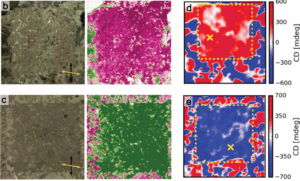
An exemplary publication resulting from this research: – M. Szustakiewicz et al., Adv. Funct. Mater. 2025, 35, 2500933. DOI 10.1002/adfm.202500933
We are experts in luminescent chiral composites.
Beyond absorption, our chiral templates organise luminescent nanocrystals into films that emit circularly polarised light with high dissymmetry factors. This adds an emission channel to the authentication toolbox and enables marks that appear only under UV excitation.

An exemplary publication resulting from this research – M. Pawlak et al., Angew. Chem. Int. Ed. 2026. DOI 10.1002/anie.202507812
How we work with industry
Our research targets document security, brand protection and the authentication of pharmaceuticals and luxury goods. A patent application covering an optical authentication feature based on chiral liquid-crystal films was filed in 2026, and further filings are in preparation. We collaborate with security printers, converters and brand owners on feasibility studies and technology evaluation, from reference samples and demonstration readouts to joint development. All industrial projects are conducted under non-disclosure agreements.
Contact us at wlewandowski@chem.uw.edu.pl